Reviewed · OSAKA
Sharpen Japanese Knives in Osaka
Knife sharpening is an art, not a chore. This small Sakai workshop pairs history with hands-on sharpening using whetstones. You leave knowing what to do the next time your blade feels dull.
I like that this is built around real Sakai knife culture, including how knives are made by hand and the many roles different blades play. I also like the practical workshop at Wada Store, where you use the sharpening tools and learn the proper technique. One thing to consider is the time: about two hours is tight, so you will want to show up ready to focus (and bring a knife you actually care about).
In This Review
- Key highlights you will feel right away
- Why Sakai is the right place for Japanese knife sharpening
- Meeting at Wada Store, and what the tour gives you
- Stop 1, the Sakai Traditional Industrial Hall: see the craft before the whetstones
- Stop 2 at Wada Store: sharpening with whetstones the hands-on way
- The technique that turns sharpening into a skill you can repeat
- Tools, included gear, and what you should bring
- Price and value: is $213 fair for two hours in Sakai?
- Timing, walking, and how to fit this into your Osaka day
- Weather reality, small group perks, and who should book
- Should you book the Sharpen Japanese Knives in Osaka workshop?
- FAQ
- How long is the knife sharpening experience?
- What is included in the tour price?
- Do I need to bring a knife?
- Where do I meet the guide?
- What stops are part of the experience?
- Is admission included for the first stop?
- How many people are in the group?
- What happens if the weather is poor?
- What is the cancellation policy?
Key highlights you will feel right away
- Sakai knife culture, explained simply, with a look at handmade processes and different knife types
- Hands-on sharpening with whetstones, not just watching someone else work
- Handle fitting taught traditionally, so the lesson is about more than just sharpening
- Small group size (max 5 travelers), which helps you get personal attention
- Coffee or tea included, because good craft work deserves a break
Why Sakai is the right place for Japanese knife sharpening
Sakai, just south of central Osaka, has a reputation for knife work that goes way back, and you can still feel that craft energy in the neighborhood. The big idea here is that Japanese knives are not treated like disposable tools. They are treated like equipment with a life cycle, maintenance included.
That mindset is exactly what makes this experience valuable. Even if you cook at home every day, you might only think about sharpening when something feels too dull to ignore. This tour gives you a more useful view: sharpening is part of owning the knife properly.
You also get context on the variety of knives made for different jobs. When you understand that, you sharpen with more purpose. You stop treating every blade the same.
Osaka is Japan's kitchen, and Kyoto, Nara, and Himeji are all close enough for a day trip.
- Osaka Go Karting Tour with Funny Costume★ 5.0 · 2,658 reviews
- Osaka Castle: Museum and Tower Entry Ticket★ 4.5 · 2,380 reviews
- Osaka: Shinsekai Food Tour with 13-15 Dishes at 5 Eateries★ 4.8 · 2,204 reviews
- Osaka Food Tour: 13 Dishes at 5 Local Eateries★ 5.0 · 2,149 reviews
- Hungry Osaka Street Food Tour:15 Tastings & 3 Drinks with a Local★ 5.0 · 1,727 reviews
Meeting at Wada Store, and what the tour gives you
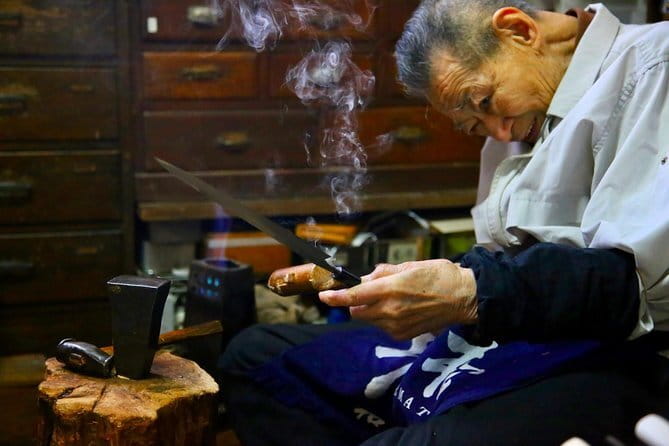
You meet at Wada Store, 1-chōme-1-1 Shinmeichōhigashi, Sakai Ward, Sakai 590-0935. The tour uses a mobile ticket, and the group stays small, up to five people, which helps keep the lesson from turning into a lecture.
You are not walking in empty-handed. You will get an apron, and the tour provides the sharpening tools you need. You also bring the star of the show: your knife. Plan to bring one you can practice on, ideally a blade that you actually use, not your best ceremonial piece that you are afraid to touch.
Coffee and/or tea are included, so you are not stuck hunting for a drink during the schedule. The session runs about two hours total, and it ends back where you started.
Stop 1, the Sakai Traditional Industrial Hall: see the craft before the whetstones
The first stop is the Sakai Traditional Industrial Hall. Your time there is about 30 minutes, and the admission ticket for this part is free. This is the setup phase, the moment where you learn what you are about to sharpen and why these knives matter.
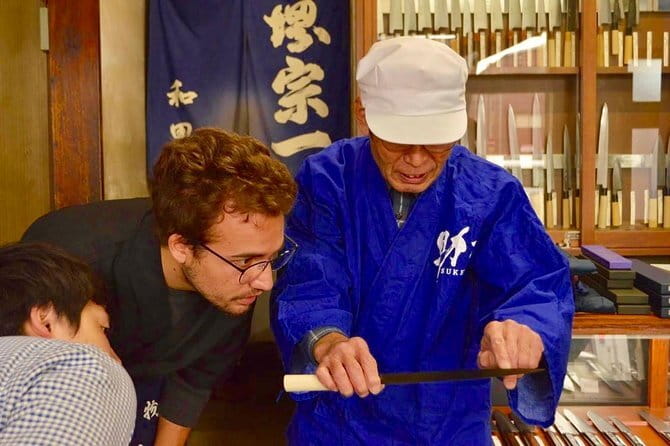
You get shown how many knives exist for different purposes. That might sound obvious until you see how much design varies based on use. You also learn about how knives are made by hand. The goal is not to memorize a history quiz. It is to understand the difference between a knife that feels right and one that is just sharp in theory.
A practical bonus here is mental preparation. If you already know what makes a blade type special, the sharpening lesson makes more sense. You do not just follow steps. You understand what you are trying to fix.
Stop 2 at Wada Store: sharpening with whetstones the hands-on way
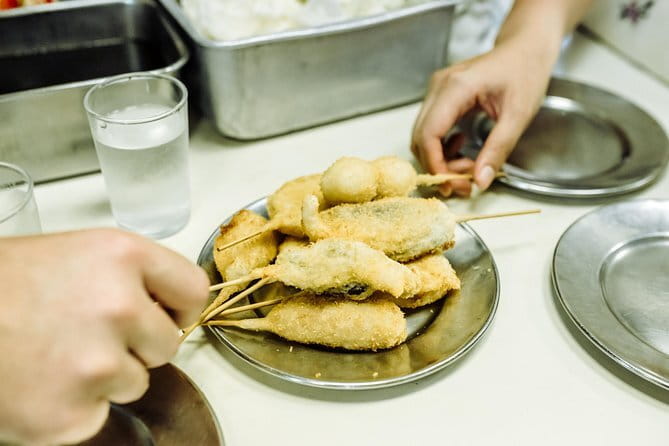
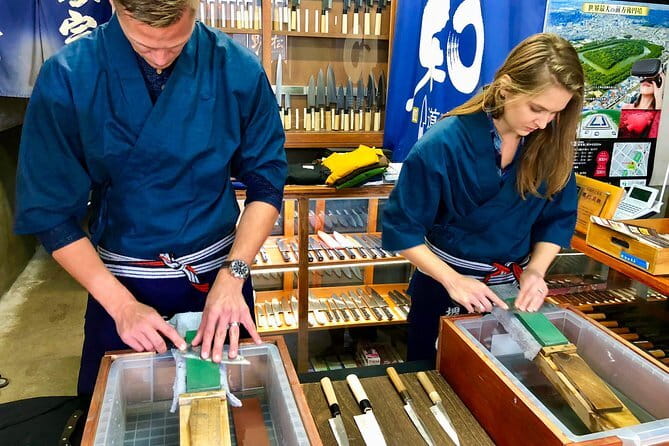
The second stop, about 1 hour 30 minutes, is the main workshop at Wada Store. This is where the sharpening lesson happens with a sharpener using whetstones. This is also where you learn how to do it properly, not randomly.
The lesson is hands-on, which is what you want for something like sharpening. Watch a couple of minutes, then try. You will learn the correct way to sharpen and how to keep control. The instructor also covers how to fit the handles into the blades traditionally.
That handle-fitting part is surprisingly useful, even if your knife already has a handle. Why? Because it teaches you that knives are a system. Blade quality, balance, and handle fit all affect how your knife performs, and sharpness is only one part of the equation.
If you get a guide like Yuji, you are in good shape. In one of the reviews, Yuji met the group on time at Sakai station, walked them about a half mile to the knife museum area, and explained the displays and workshop in very good English. That kind of clarity makes a big difference in a skill lesson.
The technique that turns sharpening into a skill you can repeat

You are not just learning to make a blade feel sharp for today. You are learning how to repeat the process later at home. That is why the workshop focuses on proper sharpening steps and tool use.
With whetstones, the details matter. Pressure, angle, and consistency decide whether you create a clean edge or just grind the knife in circles. In the workshop format, you get coaching on what you are doing, which is the fastest way to improve. Instead of guessing, you correct in real time.
Then comes the extra craft piece: fitting handles traditionally. Even if you never plan to re-handle your knives, you get a better appreciation for how tools are built and maintained. That makes you treat your knives with more care, which usually means they stay in better shape for longer.
Not ready to leave Osaka yet? A few more ways to fill the day.
- Osaka: Tea Ceremony Experience
★ 4.9 · 1,426 reviews - Osaka Kickstart: Hotspots & Hidden Gems Tour
★ 5.0 · 1,306 reviews - Deep Backstreet Osaka Tours (Option to add Dinner)
★ 5.0 · 1,290 reviews
Tools, included gear, and what you should bring
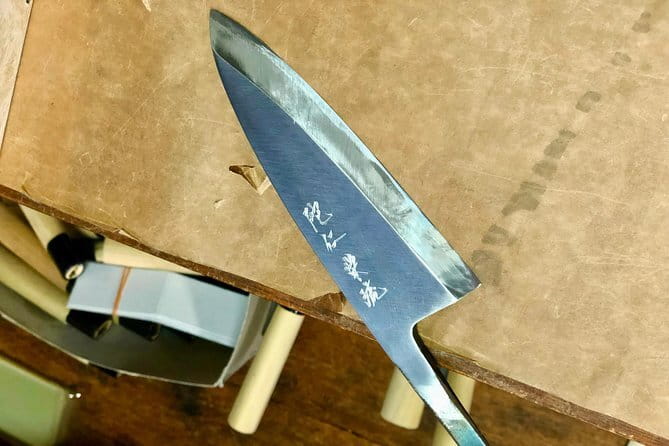
Here is what is included: an apron, the sharpening tools, your knife, and coffee or tea. That means you do not need to show up with a whetstone bag like you are starting a new hobby. The workshop supplies the equipment for the lesson.
What you should bring:
- Your knife (the one you want to learn how to maintain)
- Comfortable shoes for the short walk between stops (the area is walkable, but you will move)
- A willingness to slow down and focus for the full lesson
What you should not expect:
- Lunch, dinner, or snacks. You are on a tight schedule, so plan food around your start and end time.
If your knife is very damaged, you might find the workshop still helps you understand the basics. But it is smart to choose a knife that will respond well to sharpening, so you can see results quickly.
Price and value: is $213 fair for two hours in Sakai?

The price is $213 for an experience that runs about two hours, includes the sharpening lesson, tools, an apron, and coffee or tea, plus admission is handled at the first stop. There are a lot of tours that charge for a quick look and photo time. This one is different because you are paying for skill time.
What justifies the cost is the hands-on portion with a sharpener, plus the small group size of up to five travelers. That attention matters. Sharpening is hard to learn from a video. It is much easier when someone corrects your angle and technique while you are working.
You are also getting a “two-layer” experience. First, you see how knife making fits into the local industrial culture. Then you apply it immediately to sharpening a knife you own. That combination makes the workshop more than a standalone activity.
If you love cooking tools, metalwork, or you simply want your Japanese knives to stay useful, this is a strong value for the time.
Timing, walking, and how to fit this into your Osaka day

This works well as a half-day style stop. It starts at Wada Store and ends back at the meeting point. In one review, the guide met the group at Sakai station and the walk to the museum was about a half mile, so plan for some walking between the two locations.
It is also close to public transportation, so you do not need a car or a private taxi plan. Just be ready to move a bit and arrive early enough to settle in.
Because it is only about two hours, you should plan your Osaka day around it. Do not schedule this when you are rushing for another train transfer right after. Give yourself a buffer, so the skill lesson stays stress-free.
Weather reality, small group perks, and who should book
This experience requires good weather. If it gets canceled due to poor weather, you are offered a different date or a full refund. That is a normal condition for outdoor-adjacent city walking, but it matters for planning.
The small group size, max five travelers, is one of the reasons this tour gets consistently high marks. You are not lost in the back row. You get room to ask questions and work your own knife.
This tour is a great match if:
- You own Japanese knives and want to learn real maintenance
- You like hands-on workshops more than museum-only visits
- You want to understand why different knife types exist and how they are made
It may be less exciting if you want a purely scenic Osaka experience, because this is craft-focused. It is not a sightseeing sprint. It is a skill lesson with history woven in.
Should you book the Sharpen Japanese Knives in Osaka workshop?
Book it if you want an experience that actually changes what you can do at home. The biggest win is the mix of practical sharpening instruction with Sakai craft context, plus the small group format that supports learning. Also, if you can get a guide like Yuji, you are in good hands with clear English and a friendly, expert approach.
Skip it only if you are short on time and cannot spare about two focused hours, or if you would feel uncomfortable bringing your own knife to the workshop. Otherwise, this is the kind of activity that turns a vacation into a long-term upgrade for your kitchen.
FAQ
How long is the knife sharpening experience?
It runs for approximately 2 hours.
What is included in the tour price?
The tour includes an apron, sharpening tools, coffee and/or tea, and your knife for the workshop.
Do I need to bring a knife?
Yes. You bring your knife to use during the sharpening lesson.
Where do I meet the guide?
You meet at Wada Store, 1-chōme-1-1 Shinmeichōhigashi, Sakai Ward, Sakai, Osaka 590-0935, Japan.
What stops are part of the experience?
You visit the Sakai Traditional Industrial Hall and then go to Wada Store for the sharpening lesson.
Is admission included for the first stop?
Admission is free for the Sakai Traditional Industrial Hall.
How many people are in the group?
The tour has a maximum of 5 travelers.
What happens if the weather is poor?
The experience requires good weather. If it is canceled due to poor weather, you will be offered a different date or a full refund.
What is the cancellation policy?
This experience is non-refundable and cannot be changed for any reason.