
Reviewed · TAIKO DRUMMING EXPERIENCES
Osaka: UTAGE Japanese Taiko Live Show
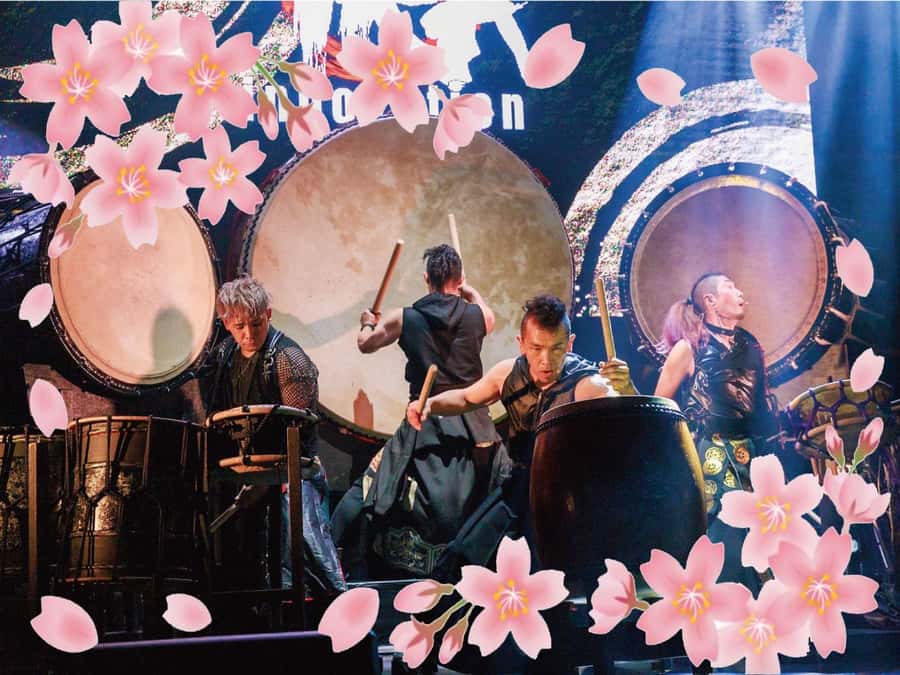
That 180 cm drum steals the show.
In UTAGE, Japanese drums, shamisen, shakuhachi, shinobue, and computer music slam into a small Osaka theatre, and I love the near-stage energy plus the hands-on chance to play for one song. One heads-up though, once the show starts you cannot enter, so plan to arrive early and not gamble with timing.
The program is built for impact. The core group is TRAinnovation, a band credited in the show materials with a world number one indie band title, and they bring a modern, visual style to very old sounding instruments. If you like performances that mix tradition and hype, this is a fun bet, and it is priced to be reasonable for what you get at an Osaka Cultural Center location.
In This Review
- Key points to know before you go
- Getting there: Osaka Cultural Center and the 5-minute rule
- What UTAGE actually is: taiko, koto-style instruments, and computer beats
- The lineup on stage: shamisen, shakuhachi, and shinobue in a modern show
- The 180 cm taiko drum: why this show feels bigger than it looks
- The crowd interaction: one song where you become part of the rhythm
- Visual energy and the modern twist you can feel
- Photos and the downstairs add-on: meeting the band and trying the props
- Price and value: is $40 worth it in Osaka?
- Who should book UTAGE, and who might skip it
- Should you book the UTAGE Japanese Taiko Live Show in Osaka?
- FAQ
- Where is the UTAGE Japanese Taiko Live Show located?
- How much does UTAGE cost?
- What instruments are included in the show?
- Is the show performed in Japanese or English?
- Can I participate in the performance?
- Are photos allowed?
- Is there anything to do after the show?
- Do I need to arrive early?
- Can I reserve and pay later?
- What is the cancellation policy?
Key points to know before you go
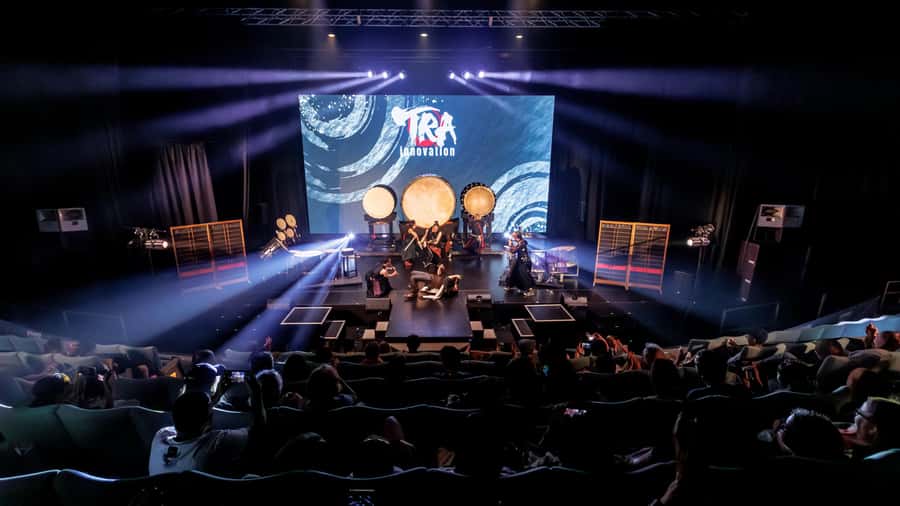
- 180 cm taiko drum: the giant drum tied to Kansai comes front and center.
- Traditional instruments, modern sound: taiko, shamisen, shakuhachi, shinobue with computer music backing.
- Small theatre feel: the band sits just a few metres from the audience, making it feel intimate.
- Audience participation: you can join for one song during a limited slot.
- Photo opportunities after: you can take pictures with the band afterward, plus there is an additional downstairs photo moment.
- Japanese-only show: the program language is Japanese, so rhythm matters more than words.
Getting there: Osaka Cultural Center and the 5-minute rule
UTAGE meets at Osaka Cultural Center, and the experience ends back at the same meeting point. That simple start and finish matters in Osaka, where it is easy to bounce between stations and forget where you parked your timing.
Plan to arrive at least 5 minutes early. The show production runs on a tight schedule, and once it begins you will not be allowed entry. This is one of those cases where showing up “almost on time” can quietly ruin your evening, so give yourself a buffer and be in your seat before the lights change.
Language is Japanese, so think of this as a music-first show. You do not need to understand every cue to follow what is happening. If you are the type who reads a venue like a puzzle, you will still enjoy it, because the action and visuals do a lot of the work.
Feel the drums before you hear them
- OSAKA NIGHT FUSION Japanese Taiko Kabuki Samurai Dance Show★ 4.8 · 155 reviews
- Osaka: UTAGE Modern Japanese Taiko Live Show★ 5.0 · 81 reviews
- Osaka: A Modern Samurai, Kabuki, Taiko, & Dance Show★ 4.5 · 66 reviews
- Osaka:SUMO BEATS SHOWCASE: Taiko Drum and Wagyu burger!★ 4.2 · 37 reviews
- OSAKA:Feel the Power! Learn Taiko Drum from Professionals★ 5.0 · 28 reviews
What UTAGE actually is: taiko, koto-style instruments, and computer beats
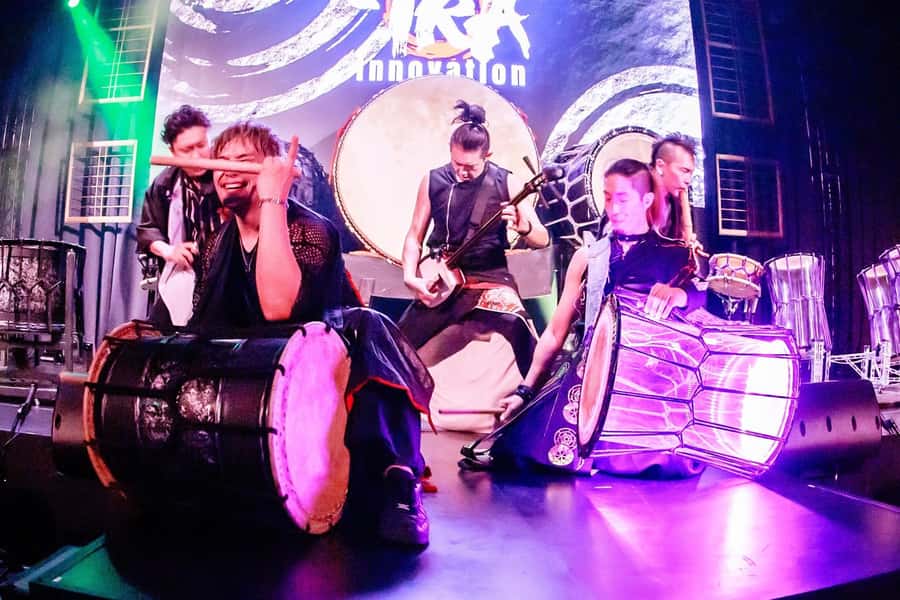
UTAGE LIVE SHOW is a coordinated lineup of Japanese instruments, with one key twist: it is not purely acoustic. The sound world includes Japanese drums, shamisen, shakuhachi, and shinobue, and then layers in computer music for a modern edge.
The result is a performance that feels current without pretending the instruments are new. The traditional timbres are still there, but the pacing can feel like a live concert. You get sections where the instruments lead, and sections where the computer backing tightens the groove and makes everything hit harder.
The band behind the show is TRAinnovation, and they handle the flow as a group. The program is designed for all nationalities, which shows in how the musicians interact with the audience. Even when you do not catch a word, you can read the energy shifts and the body language.
The lineup on stage: shamisen, shakuhachi, and shinobue in a modern show

Here is what you can expect from the instrument mix, in plain terms.
Shamisen brings a sharp, plucked, almost percussive character. When it shows up, it often feels like it is cutting through the sound so your ears latch onto a melody line fast.
Shakuhachi is breathy and haunting. When the show gives space to the shakuhachi, it adds contrast. That contrast matters because UTAGE is high-energy overall, and you need quieter moments to make the loud parts land.
Shinobue is a clear, front-of-the-mix flute sound. In a performance like this, it often functions like a lead voice, the kind of line that makes you realize the rhythm has a storyline.
Then there is taiko, with the biggest role being the giant drum that is part of the show. The point is not that you are hearing one instrument. You are hearing a whole toolkit used like a band, with moments that switch texture so the show never goes flat.
The 180 cm taiko drum: why this show feels bigger than it looks
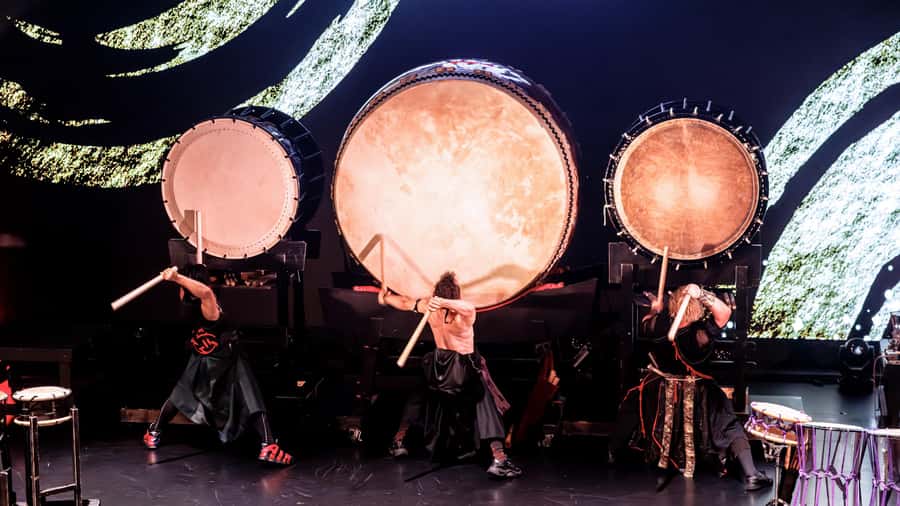
The headline detail is the largest drum in Kansai, with a diameter of 180 cm. That number is not just a marketing stat. It changes how you experience sound, because a drum that size does not just sound loud. It feels physical.
In this kind of staging, the drum becomes a centerpiece that anchors the performance. When it gets introduced, the music tends to reorganize around it. You see the band move differently when the drum is the focus, and you get the sense that the sound is shaping the room rather than simply filling it.
Also, the show is staged so you are close. One account describes the audience in a small theatre with the performers only a few metres away. That proximity matters for taiko. If you are far back, taiko can become generic thunder. Close up, it becomes timing, breath, and impact.
If you love drumming, this is the part you will remember the most. If you are skeptical about whether a “taiko show” can feel original, the size and staging are exactly why this one has momentum.
The crowd interaction: one song where you become part of the rhythm
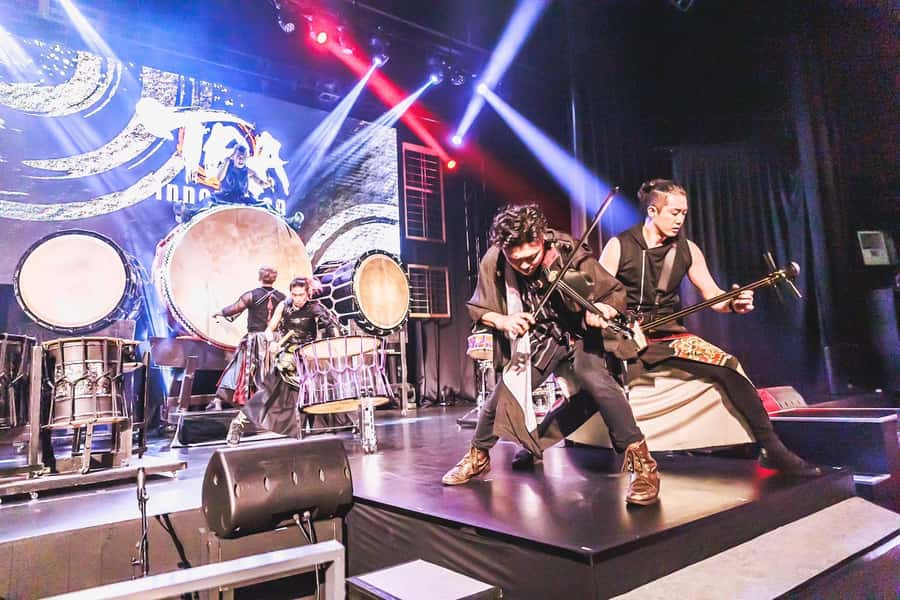
UTAGE is not just a seated watch. It includes a chance to participate as a performer for one song for a limited time.
This is one of the best features because it turns a passive activity into something you can tell stories about. Even if you only play a small part, you learn the show’s rhythm and pacing from the inside. You also see how the musicians guide the group so it does not become chaos.
The interaction has a rehearsed quality, not a random gimmick feel. The band engages the public, and the show design gives you a clear moment to step forward, play along, and then return to the audience seats.
If you travel with kids, this is often a big reason to pick UTAGE. Several people highlight that it is fun for families and that the audience interaction keeps it moving.
Other ways to spend a day in Osaka
- Osaka: Sumo Show & Experience w/ Optional Kimono & Hot Pot
★ 4.5 · 609 reviews - Osaka: Sumo Stage Show with Bento or Snack + Fight & Photo
★ 4.3 · 364 reviews - Osaka: English Stand Up Comedy Show at Osaka Comedy Club
★ 4.7 · 203 reviews
Visual energy and the modern twist you can feel
The show materials point to visual elements built into the program, and the vibe is definitely not purely traditional in presentation. Computer music plus stage energy plus rapid changes in the lineup can make this feel like a contemporary concert that happens to use Japanese instruments.
That matters if you worry that cultural shows will be slow or stiff. UTAGE is paced to keep attention. Even if you are there for the instruments, you are likely to leave talking about the show as a whole because it is engineered for momentum.
One practical takeaway: if you prefer long, meditative performances with minimal talking, UTAGE may feel too energetic. But if you like music with personality, this style tends to click quickly.
Photos and the downstairs add-on: meeting the band and trying the props

UTAGE includes strong post-performance moments. You can take photos during the performance (as reported by participants), and you can take pictures with the band after the show.
There is also an extra stop in the flow, a shop located downstairs, where visitors can pose for complimentary photos with samurai swords and traditional Japanese umbrellas. That part is optional, but it is a fun souvenir without the hard-sell feeling. Think of it as a quick photo moment that extends the show’s energy beyond the stage.
If you are traveling with someone who loves souvenirs or who enjoys dressing up for photos, this is a nice bonus. It can turn a one-hour performance into a more complete experience for the evening.
Price and value: is $40 worth it in Osaka?
At $40 per person, UTAGE is priced in a way that makes sense for a live, near-stage performance with a professional band and a giant instrument feature.
Here is how I look at the value:
- You are close. A small theatre setup described by one attendee makes the show feel almost private. That proximity is part of what you pay for.
- You get more than watching. One-song participation, plus photo time with the band afterward, makes it feel interactive.
- The production uses multiple sound worlds. Traditional instruments plus computer music means you are not paying just for taiko alone.
Could you find cheaper cultural performances? Sure. But cheaper often means farther away, fewer production touches, and less interaction. For UTAGE, the mix of big stage moments and audience involvement is what justifies the ticket.
If you are budgeting for Osaka, this is a good pick when you want a night activity that is easy to understand even without Japanese language.
Who should book UTAGE, and who might skip it

UTAGE works best if you want:
- A high-energy music show that mixes traditional instruments with modern sound
- A hands-on moment where you can join for one song
- A family-friendly atmosphere where kids usually do not get bored
You might choose a different evening option if:
- You want a quiet, lecture-style cultural presentation
- You are sensitive to loud percussion and fast show pacing
- You need an English narration layer, because the show is Japanese and the experience is built primarily through sound and visuals
Should you book the UTAGE Japanese Taiko Live Show in Osaka?
Yes, if you want a memorable Osaka night that feels close, interactive, and genuinely fun. The combination of a 180 cm Kansai taiko drum, the instrument lineup (shamisen, shakuhachi, shinobue), and the TRAinnovation band energy is a strong package for $40.
Just treat it like a real show. Arrive early because entry is limited once it starts, and go with an open mind about the modern computer music twist. If you do, you will likely walk out talking about the drum and the moment you got to play.
FAQ
Where is the UTAGE Japanese Taiko Live Show located?
The show starts at Osaka Cultural Center and ends back at the same meeting point.
How much does UTAGE cost?
The price is $40 per person.
What instruments are included in the show?
The lineup includes Japanese instruments such as Japanese drums (including a 180 cm drum), shamisen, shakuhachi, and shinobue.
Is the show performed in Japanese or English?
The show language is Japanese.
Can I participate in the performance?
Yes. You can participate as a performer for one song during the show for a limited time.
Are photos allowed?
Photos are reported as allowed during the performance, and there are also photo opportunities afterward with the band.
Is there anything to do after the show?
After the performance, the experience continues at a shop downstairs, where visitors can pose for complimentary photos with samurai sword and traditional Japanese umbrella props.
Do I need to arrive early?
Yes. You should arrive at least 5 minutes before the start of the show, and once it begins you cannot enter.
Can I reserve and pay later?
Yes. You can reserve and pay later, booking your spot without paying today.
What is the cancellation policy?
You can cancel up to 24 hours in advance for a full refund.
Just added around Osaka


Taiko Drumming Experiences, compared.

OSAKA NIGHT FUSION Japanese Taiko Kabuki Samurai Dance Show
Read our review →


SUMO BEATS SHOWCASE: Taiko Drum and Wagyu burger!
Read our review →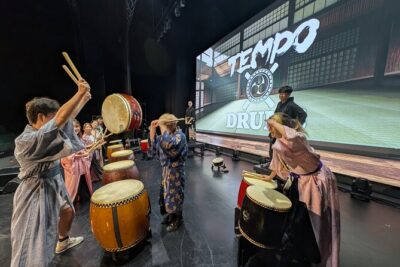
Feel the Power! Learn Taiko Drum from Professionals
Read our review →Feel the Power! Learn Taiko Drum from Professionals
Read our review →
This tour also fits